

Key Health Care Information for Medicare and the Marketplace
October means open enrollment time for both Medicare and under-65 health insurance. The choices you make this fall lock in your costs for all of 2027, and several rules and numbers have changed. Here is what you need to know:
Medicare
Annual Enrollment runs October 15 through December 7. Anyone on Medicare can shop for their Medicare Part D drug plan or Medicare Advantage plan during this window. Changes take effect January 1.
Review your Part D plan every year, even if you are happy with it. Plans change their premiums, covered drug lists, and preferred pharmacies every year. The plan that was cheapest for your prescriptions last year may not be this year. Enter your current prescriptions into the Plan Finder at Medicare.gov, or let us run the comparison with you.
Part D cost-sharing limits are increasing in 2027. The maximum deductible rises to $700 (from $615 in 2026), and the annual out-of-pocket cap rises to $2,400 (from $2,100). Once you reach the cap, covered drugs cost $0 for the rest of the year.
Already in a Medicare Advantage plan? You get one more chance to change. Between January 1 and March 31, people enrolled in a Medicare Advantage plan can make one change: switch to a different Advantage plan, or return to Original Medicare and add a Part D plan. This window cannot be used to move from Original Medicare into Advantage or to switch stand-alone Part D plans. Keep in mind that returning to Original Medicare does not guarantee you can buy a Medicare supplement, which may require medical underwriting.
Medicare supplements, often called Medigap plans, can be shopped at any time, but usually require medical underwriting. Outside of your initial enrollment window, the insurance company can decline you or charge more based on your health, and the Annual Enrollment period does not change that. If you are healthy and your supplement premium keeps climbing, it may be worth pricing the same plan with other companies while you can still qualify.
Missouri residents have an extra option. Missouri’s anniversary rule lets you switch to the same Medigap plan (for example, Plan G to Plan G) with any company, with no health questions, if you act within 30 days of your policy’s anniversary date. Kansas does not currently have a similar rule.
IRMAA: watch your income from two years ago. Higher-income Medicare beneficiaries pay a surcharge on Part B and Part D premiums called IRMAA. It is based on your tax return from two years earlier, so your 2027 premiums are based on your 2025 income, and the income you create this year will set your 2028 premiums. In 2026, surcharges began at modified adjusted gross income above $109,000 for single filers and $218,000 for joint filers. The 2027 thresholds and Part B premium will be announced later this fall.
IRMAA works like a cliff: going $1 over a threshold triggers the full surcharge for that bracket. Roth conversions, large IRA withdrawals, capital gains, and the sale of a business or property are the usual culprits.
If your income has dropped because of certain qualifying life-changing events, such as retirement, reduced work, the death of a spouse, or divorce, you may be able to ask Social Security to use more recent income information by filing Form SSA-44.
Under 65: The Health Insurance Marketplace
Open enrollment begins November 1, 2026 on HealthCare.gov, which both Kansas and Missouri use. As of September 2026, HealthCare.gov lists January 15, 2027 as the final enrollment deadline.
December 15 is the date that matters most. Choose your plan by December 15 for coverage that starts January 1. Plans chosen after that start February 1, which can leave a gap in coverage.
Do not let your plan simply auto-renew. Premiums are rising again for 2027, several insurers are leaving markets or shrinking, and your plan’s doctors and hospitals may change. If your plan is discontinued, you could be moved into a replacement you did not choose. Log in, update your income estimate, and compare.
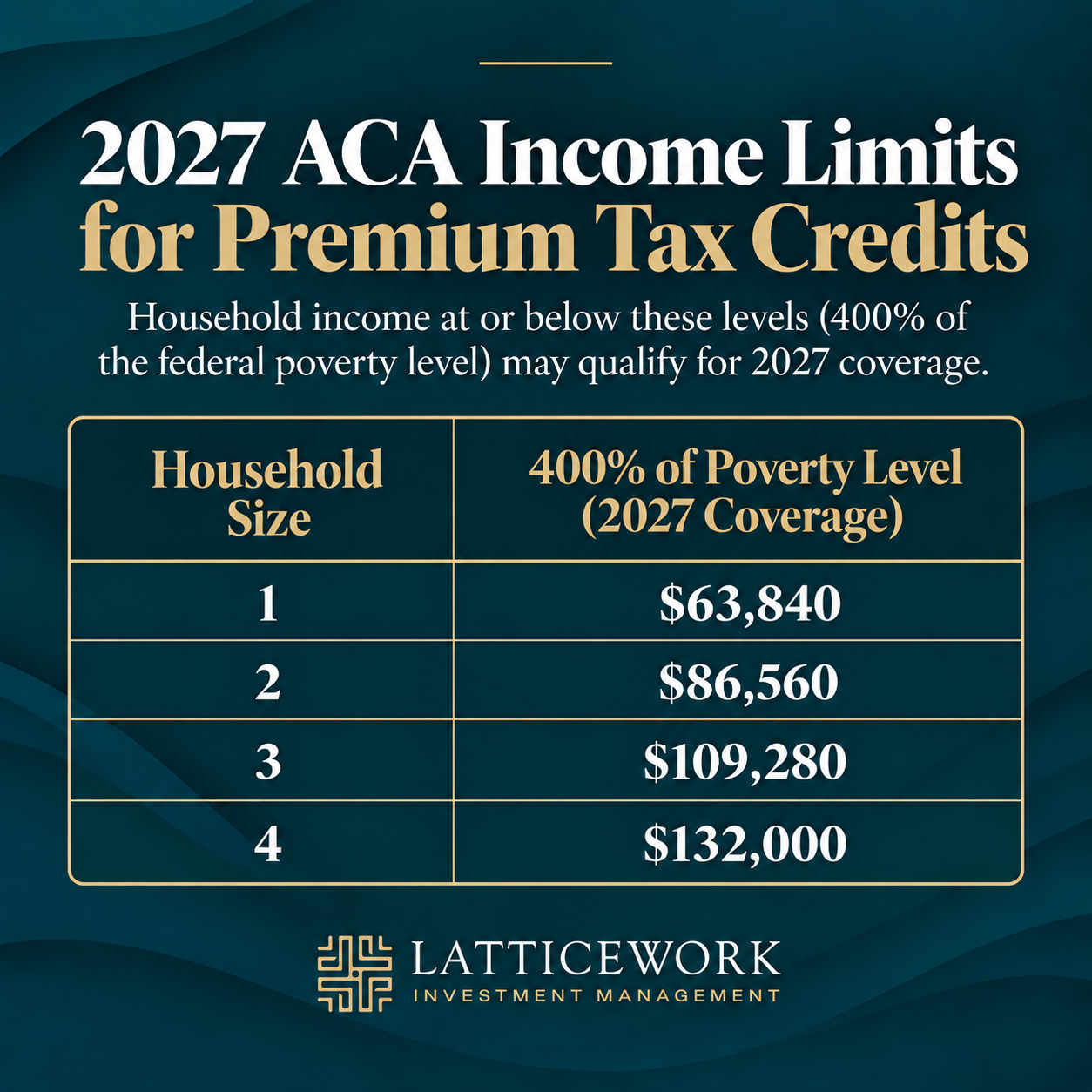
Income limits for tax credits are back. The enhanced subsidies in place from 2021 through 2025 expired at the end of 2025 and have not been renewed. For 2027 coverage, premium tax credits are available only to households with income between 100% and 400% of the federal poverty level. Above 400% of the federal poverty level, the premium tax credit is generally unavailable, so even a small amount of income above the limit can result in the loss of a substantial premium tax credit.

If your income is under the limit, you are expected to pay between 2.15% and 10.22% of your income for the benchmark silver plan, and the tax credit covers the rest.
Income here means modified adjusted gross income: your adjusted gross income plus tax-exempt interest and any Social Security that is not taxed.
Kansas did not expand Medicaid, so Kansans with income below 100% of the poverty level ($15,960 for a single person) do not qualify for tax credits. Missouri expanded Medicaid to 138% of the poverty level.
End of year tax planning items are more important than ever. Health insurance costs and taxes are now tightly linked, so the last few months of the year are the time to act:
The repayment cap is gone. Starting with 2026 tax returns, there is no limit on how much of your advance tax credit you may have to pay back. If your 2026 income ends up higher than you estimated, especially above 400% of the poverty level, you could be required to repay some or all of the advance premium tax credit at tax time. Check your projected 2026 income before December 31 while you can still do something about it.
Ways to lower your income before year end. Depending on your circumstances, strategies that may reduce your modified adjusted gross income include pre-tax retirement plan contributions, deductible traditional or SEP-IRA contributions, health savings account (HSA) contributions, and realizing investment losses to offset taxable gains.
More people can use an HSA. Beginning in 2026, bronze and catastrophic individual-market plans that meet the new statutory requirements can qualify for HSA contributions. HSA limits are $4,400 for individuals and $8,750 for families in 2026, rising to $4,500 and $9,000 in 2027, plus $1,000 more if you are 55 or older.
Time your big income events. Roth conversions and large capital gains can wipe out a subsidy. In a low-income year, they may make sense up to a point, so run the numbers before year end rather than after.
Approaching 65? Remember the two-year IRMAA lookback. In many cases, income earned around age 63 can affect the Medicare premiums you pay at age 65.
How We Can Help
Health insurance decisions are really financial planning decisions. We are happy to review your Part D options, check your Marketplace income estimate, and coordinate year-end tax moves with your health insurance costs so one does not undo the other.
Advisory services offered by Latticework Investment Management, LLC. The information above is for educational and informational purposes only and should not be considered personalized financial, investment, tax, or legal advice.
Sources Medicare Part D (2027 figures) - Centers for Medicare & Medicaid Services, "Medicare Part D 2027 National Average Monthly Bid Amount Information": https://www.cms.gov/newsroom/fact-sheets/medicare-part-d-2027-national-average-monthly-bid-amount-information - Care Compass, "What Medicare Part D Will Cost You in 2027": https://www.carecompasspa.com/blog/what-medicare-part-d-will-cost-you-in-2027 - Medicare Plan Finder: https://www.medicare.gov/plan-compare Medicare Supplement (Medigap) rules - Senior65, "Missouri Medigap Anniversary Rule": https://www.senior65.com/medicare/article/missouri-medigap-anniversary-rule - SelectQuote, "Medicare Birthday Rule 2026: State-by-State Guide": https://www.selectquote.com/medicare/articles/medigap-birthday-rule-states IRMAA - Social Security Administration, Form SSA-44 (Medicare Income-Related Monthly Adjustment Amount – Life-Changing Event): https://www.ssa.gov/forms/ssa-44.pdf Marketplace open enrollment - HealthCare.gov, "Dates and Deadlines": https://www.healthcare.gov/quick-guide/dates-and-deadlines/ - Medical Daily, "Obamacare Enrollment Opens November 1 and Runs Through January 15": https://www.medicaldaily.com/aca-open-enrollment-2027-dates-premiums-deadlines-478808 Premium tax credits and income limits - Beyond the Basics (Georgetown CCF / CBPP), "Yearly Guidelines & Thresholds, Coverage Year 2027": https://www.healthreformbeyondthebasics.org/wp-content/uploads/2026/08/REFERENCE_YearlyGuidelines_CY2027-FINAL.pdf - Internal Revenue Service, "Eligibility for the Premium Tax Credit": https://www.irs.gov/affordable-care-act/individuals-and-families/eligibility-for-the-premium-tax-credit - U.S. Department of Health and Human Services, Poverty Guidelines: https://aspe.hhs.gov/topics/poverty-economic-mobility/poverty-guidelines - ASTHO, "ACA Enhanced Premium Tax Credits: Legislative Developments in 2025 and 2026": https://www.astho.org/communications/blog/2026/aca-enhanced-premium-tax-credits-legislative-developments-2025-2026/ Tax credit repayment and HSA changes - healthinsurance.org, "One Big Beautiful Bill Act Brings Sweeping Changes to Health Coverage": https://www.healthinsurance.org/blog/one-big-beautiful-bill-act-brings-sweeping-changes-to-health-coverage/ - Fidelity, "HSA Contribution Limits and Eligibility Rules for 2026 and 2027": https://www.fidelity.com/learning-center/smart-money/hsa-contribution-limits
Recent Posts